
Food sample retention
Organized, visible sample storage for food service teams.
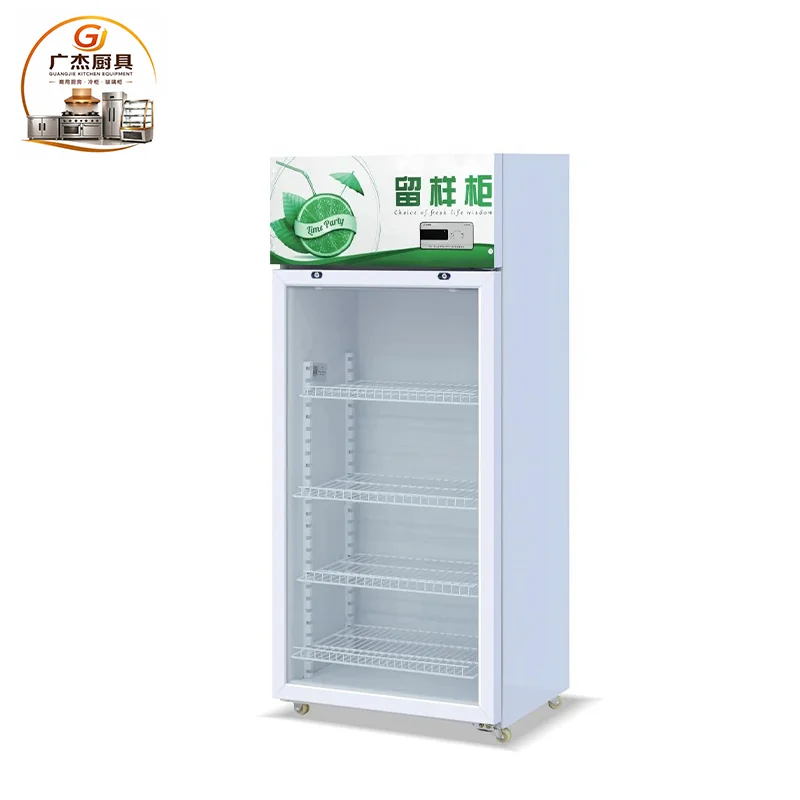
A food sample retention cabinet for meal samples in school canteens, restaurants, hotels and central kitchens. Glass doors and internal shelves keep retained items easy to identify during daily checks.
Choose by capacity
From compact counters to large kitchens
Compare the listed volume, outer dimensions and door configuration, then verify the electrical details for the order.
Single-door models
Several sizes for restaurants, smaller canteens and limited storage footprints.
Double-door model
More internal capacity for larger school canteens, hotels and food service operations.
Three-door model
A larger listed option for institutional dining and central kitchen projects.
Listed product data
Model and dimension reference
Dimensions are shown as length × depth × height in millimetres.
| Door | Model | Dimensions (mm) | Volume | Listed value (W) |
|---|---|---|---|---|
| Single | FL-60D | 410 × 410 × 800 | 60 L | 120 |
| Single | FL-80D | 510 × 480 × 835 | 80 L | 120 |
| Single | FL-100D | 510 × 480 × 1045 | 100 L | 143 |
| Single | FL-120D | 510 × 480 × 1275 | 120 L | 152 |
| Single | FL-150D | 600 × 480 × 1450 | 150 L | 152 |
| Single | FL-260D | 600 × 480 × 1700 | 260 L | 152 |
| Single | FL-400D | 600 × 580 × 1910 | 400 L | 180 |
| Double | FL-800D | 1200 × 580 × 1910 | 800 L | 220 |
| Three | FL-1200D | 1800 × 580 × 1910 | 1200 L | 310 |
The W figures are retained from the supplied product data. Please confirm the specification sheet, voltage and electrical requirements for the selected model before ordering.
Daily sample handling
Visible shelves make routine checks simpler
Glass doors allow staff to check stored samples without opening the cabinet. Internal shelves support separation by meal, date or category.
Check model availabilityFor project matching
Confirm the details that affect fit
- Required volume and model
- Available floor space and access clearance
- Number of doors and shelf arrangement
- Voltage and electrical requirements
- Quantity and packing method
- Delivery destination
Additional product view
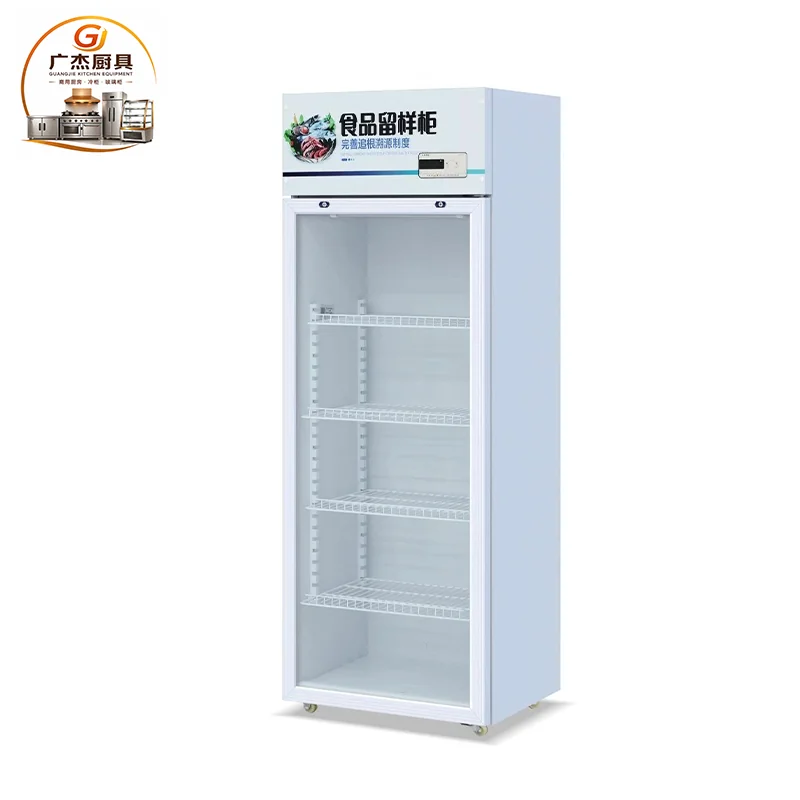
Cabinet appearance and scale
The alternate view adds context to the cabinet shown above.
Build a Clear Sample-Storage Routine
A food sample retention cabinet should be selected around the number of meals and containers your team needs to organize, the available installation space and the storage procedure used at the site. The listed range runs from 60 L to 1,200 L and includes single-, double- and three-door models. Compare the exact model dimensions and usable layout with the daily requirement; a larger listed volume does not by itself confirm that a cabinet will fit your room or container sizes.
Before choosing a size, estimate how many samples may be held at the same time and how staff will separate them by meal, date or service period. The glass door visibility and shelves described for this range can support visual checks, while the final container arrangement should follow your own operating procedure. Make sure staff can reach and identify the stored containers without crowding nearby preparation or washing areas.
Plan the cabinet position with cleaning and access in mind. Measure the floor footprint and the route from delivery to the final location, including doorways, turns, lifts and thresholds. Confirm that the selected door arrangement can open fully and that employees can load samples and remove them for routine checks. Ask for the model drawing to verify the dimensions, shelf spacing and service access before finalizing the layout.
The product information lists different dimensions and electrical values across the FL-60D to FL-1200D models. Treat those figures as model-specific: confirm the selected cabinet code, voltage, frequency, power requirement and plug or connection details for the destination. If the cabinet will be installed with other equipment, share the surrounding plan so the supplier can check spacing and access against the chosen model.
For a useful quotation, send the required storage volume, expected container sizes, preferred number of doors, available footprint, quantity and delivery destination. Ask for a written specification sheet that identifies the exact model, dimensions, volume, electrical details, included shelves and any options. Confirm packing and delivery access as well, so the quoted cabinet can be received and moved into the planned location.