News Center
Commercial horizontal freezers are essential equipment for the catering, supermarket, and food processing industries. With their large capacity (500–2,000 L) and low-temperature storage (below -18°C), they meet the bulk storage needs for meat, seafood, frozen foods, and other items. Structurally, horizontal freezers are divided into two types: top-opening and front-opening. Top-opening models (800–1,600 L) account for 70% of the market share; their advantage lies in convenient access (no need to bend over), making them suitable for storing full cases of goods. Front-opening models (500–1,000 L) are better suited for scenarios requiring frequent retrieval of small items (such as ice cream freezers in convenience stores). Statistics from a certain chain restaurant brand show that after adopting horizontal freezers, the storage costs for frozen foods decreased by 30%, primarily due to their “large capacity + low energy consumption” characteristics: a single horizontal freezer can store the equivalent of three upright freezers, while its average daily power consumption is only 12 kWh (20% lower than upright freezers).
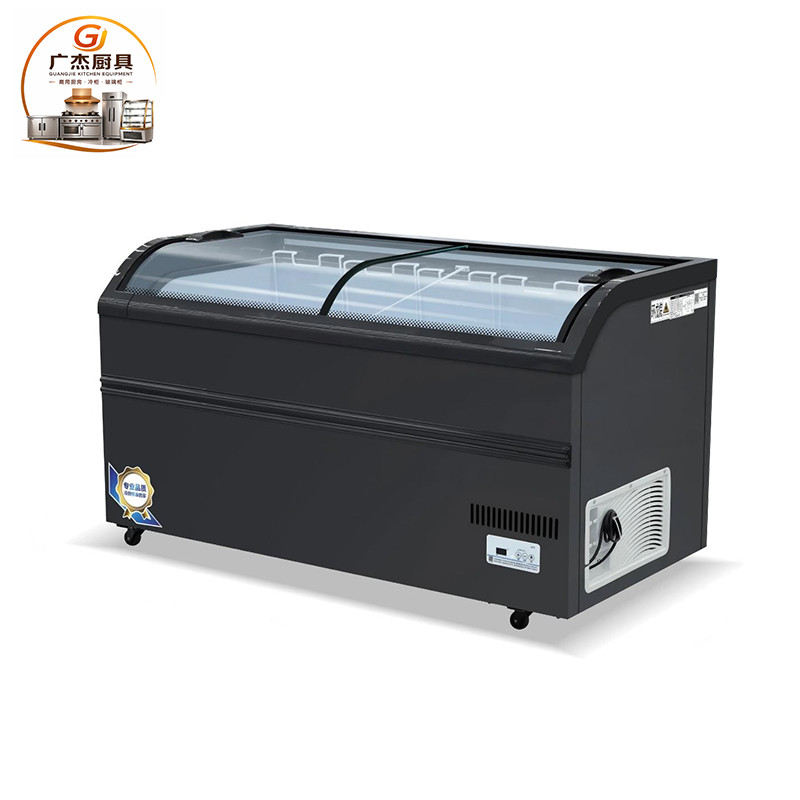
Energy-saving technology is the core competitive advantage of horizontal freezers. Traditional horizontal freezers use fixed-speed compressors and standard foam insulation (density 32 kg/m³), resulting in higher energy consumption (15–20 kWh per day). In contrast, the new models achieve 40% energy savings through three key technologies: First, they employ inverter compressors and electronic expansion valves to automatically adjust cooling capacity based on load; Second, they use VIP vacuum insulation panels (thermal conductivity of 0.004 W/(m·K)), which offer three times the insulation performance of standard polyurethane foam; third, they optimize the door seal structure with a multi-lip design (≥3 lips) and magnetic gaskets to minimize cold air leakage. Actual test data from a certain brand of chest freezers shows that under ambient temperatures of 25°C, average daily power consumption is only 9 kWh, saving 12 yuan in electricity costs per day compared to traditional models.
Smart upgrades represent the future direction. Some horizontal freezers have already integrated IoT and AI technologies to enable remote monitoring, smart defrosting, and inventory management. For example, a certain brand’s freezer uses bottom-mounted pressure sensors to monitor inventory; when the quantity of a particular item falls below a preset threshold, it automatically sends a restocking request to the procurement system. Simultaneously, by analyzing sales data (such as weekly sales volumes by category), it optimizes storage layout (e.g., placing high-demand items near the door). After a pilot program at a supermarket, the out-of-stock rate for frozen foods dropped from 12% to 4%, and inventory turnover increased by 25%. Additionally, smart defrosting technology uses sensors to monitor the thickness of frost on the evaporator and automatically initiates the defrosting process, saving 15% more energy than traditional timed defrosting while minimizing the impact of defrosting on the internal temperature.