
When selecting commercial food preparation equipment (such as sink stations, prep tables, and cutting stations), the numbers “304” and “430” may seem to differ by only one digit, but in terms of corrosion resistance and service life, the gap between the two is like night and day.
304 stainless steel, widely recognized in the industry as the gold standard for commercial kitchen equipment, consists primarily of 18% chromium and 8% nickel. Chromium forms a dense chromium oxide passivation layer on the surface of the stainless steel, which is the fundamental reason why it remains “rust-free”; Nickel plays an even more critical role—it stabilizes the austenitic crystal structure (i.e., the non-magnetic state), enabling the stainless steel to maintain excellent corrosion resistance when exposed to salt, acidic substances, and water stains, and preventing it from rusting easily even after repeated cleaning. According to the “Cold-Rolled Stainless Steel Sheets and Strips” standard (GB/T 3280-2015), equipment intended for food contact must be made of 304 or higher grade stainless steel.
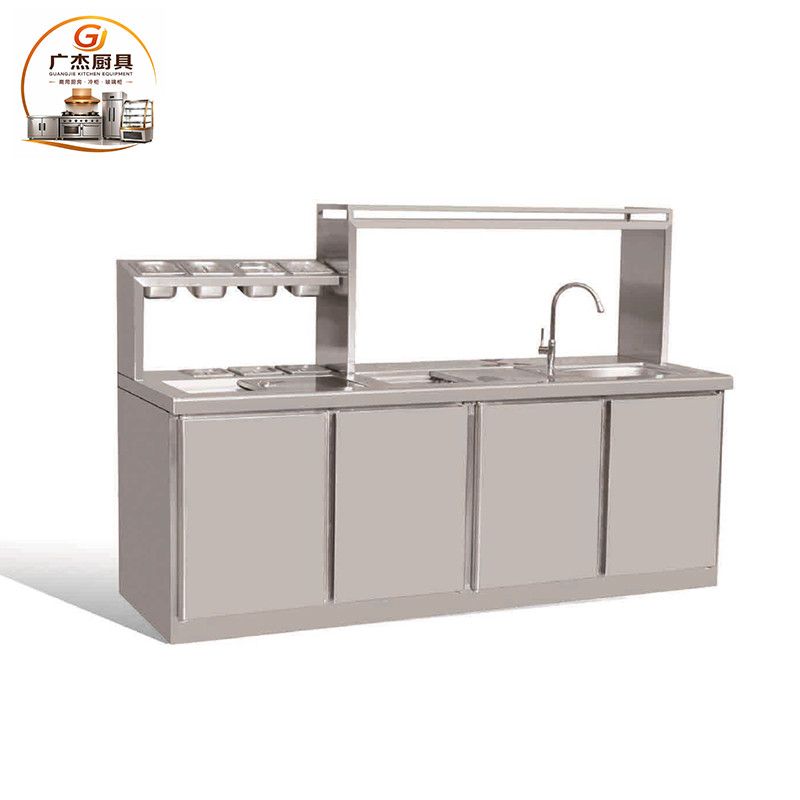
In contrast, 430 stainless steel is a ferritic stainless steel that contains only chromium and no nickel. Although it is inexpensive, its corrosion resistance is significantly compromised. The critical issue is that once the surface oxide film of 430 stainless steel is damaged in a humid environment, corrosion rapidly spreads into the material’s interior due to the absence of nickel to stabilize the structure, quickly resulting in visible “rust spots.” If used on surfaces in prolonged contact with food, the leaching of metal ions can also pose food safety risks.
For coastal areas or food service establishments with high humidity in the kitchen, there is a higher-grade option: 316 stainless steel. By adding molybdenum to the 304 composition, 316 stainless steel significantly enhances resistance to chloride corrosion, making it suitable for highly corrosive environments such as seafood processing areas and soaking stations in central kitchens. However, 316 is significantly more expensive, so ordinary food service establishments should not blindly pursue it; 304 is fully capable of meeting daily operational needs.
It is important to be vigilant, as some unscrupulous vendors on the market pass off 430 as 304, causing food service businesses to unknowingly purchase “short-lived equipment.” How can you tell the difference? A simple method is to use a specialized testing solution for a spot test—304 will remain colorless or turn pale yellow when exposed to the solution, while 430 will quickly turn reddish-brown. When purchasing, you can also request that suppliers provide material composition test reports and certification documents. This is an effective way to protect the restaurant’s legitimate rights and interests and ensure food safety standards are met.