
This commercial island freezer buying guide explains how to compare flat glass, curved glass and combination island freezers by store layout, cabinet size, capacity, customer access, display volume and electrical requirements.
The Correct Island Freezer Must Fit the Store and the Shopping Route
When deciding how to choose a commercial island freezer, begin with store dimensions, aisle width, customer access, replenishment route, product category and expected frozen-food volume. Cabinet type should follow the retail layout rather than capacity alone.
Confirm cabinet width, depth, aisle clearance, customer reach and the loading route from the stock area.
Estimate product quantity, package size, restocking frequency and the number of frozen-food categories.
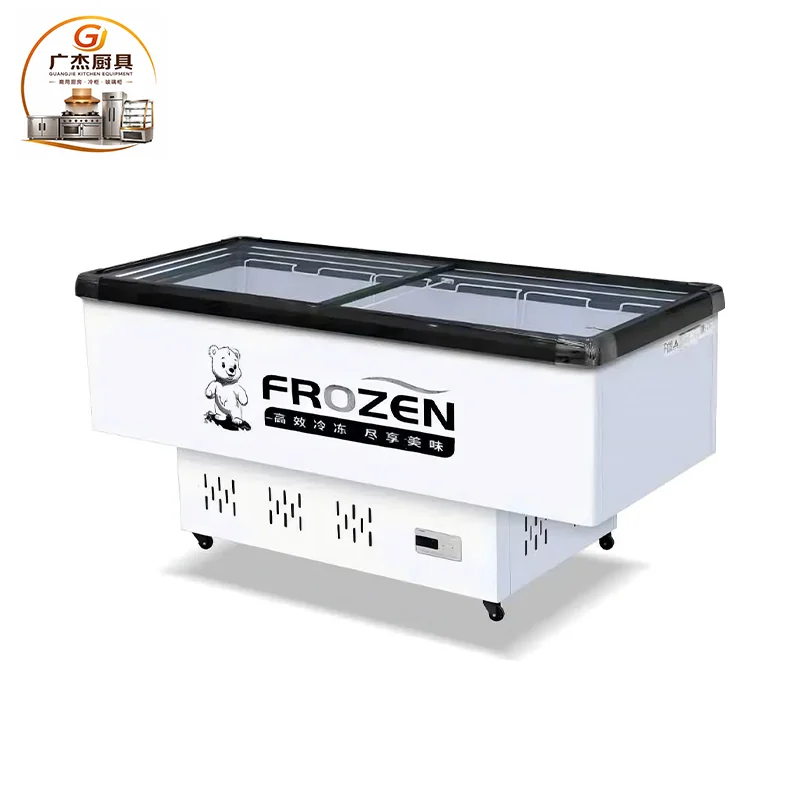
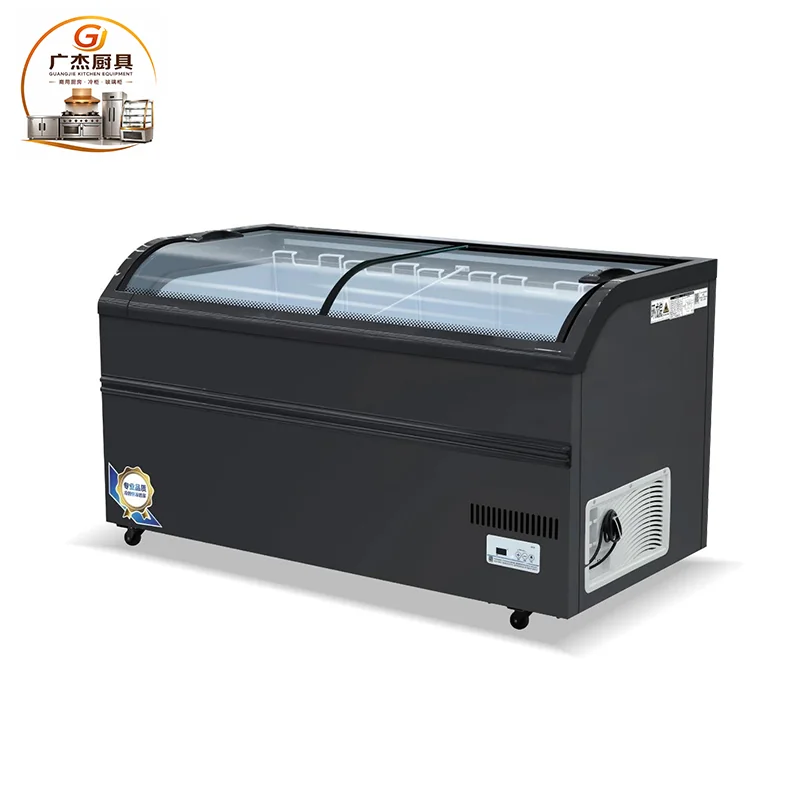
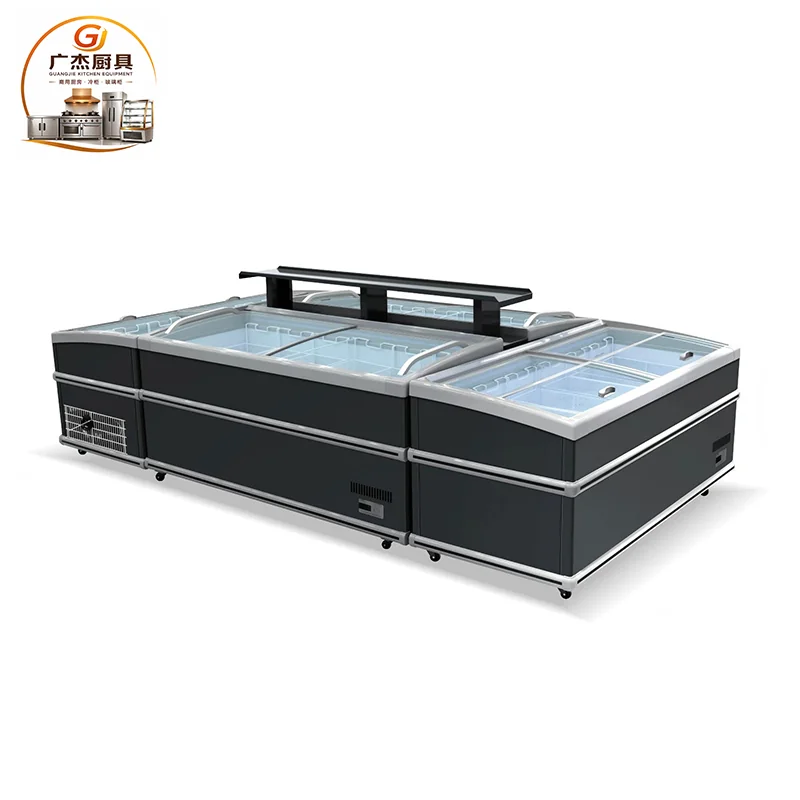
Select flat glass, curved glass or modular combination units according to visibility, store scale and layout flexibility.
Flat Glass, Curved Glass or Combination Island Freezer?
Each cabinet type serves a different purchasing need. Use the comparison below before selecting a model.
Match Cabinet Width and Depth to the Aisle
Island freezers must leave enough room for customers, shopping carts, restocking and service access. The cabinet should not block sightlines or create a narrow turning point.
Flat glass models provide the widest size range, while combination units require the whole island layout to be planned before quotation.
Reference Model Ranges
Use the ranges below as a starting point. Final operating temperature, refrigerant, voltage, plug and compressor configuration should be confirmed for the order.
Plan the Display Around Frozen Food Categories
Confirm package depth, basket arrangement and how often heavy cartons will be restocked.
Strong product visibility and clear category separation are important for customer selection.
Estimate package volume and turnover to avoid underloading or excessive empty display space.
Combination layouts can group meat, seafood, dumplings and vegetables by section or promotion theme.
Confirm the Destination Market and Store Conditions
Electrical and refrigeration specifications should be confirmed before production, especially for multi-cabinet supermarket projects.
Plan End Cabinets and Straight Cabinets as One System
A combination island freezer should be planned as a complete retail route. The number of straight modules, end sections, aisle spacing and replenishment access affect both display efficiency and customer circulation.
View Supermarket Refrigeration Planning →Commercial Island Freezer Buying Questions
Compact flat glass models such as SD/SC-1200 or SD/SC-1400 are practical starting points when floor space and aisle width are limited.
Flat glass models provide a broad model range and practical horizontal display. Curved glass models place more emphasis on customer-side visibility and front-of-house presentation.
Select a combination system when the store needs a longer modular display route using end and straight cabinets rather than one independent cabinet.
The current listed ranges cover 216–820 L for flat glass models, 400–880 L for curved glass models and 660–820 L for combination cabinet modules.
Provide the store layout, selected cabinet type, model or available space, quantity, product category, required temperature, voltage, frequency, plug and destination.
Browse independent and modular frozen-food display cabinets.
Plan frozen-food aisles, promotional zones and customer circulation.
Choose compact cabinets for limited floor space and high-turnover products.
Three island freezer checks that a catalog picture cannot resolve
The original model tables on Guangjie’s product pages reveal useful differences between freezer families. Use them as procurement checkpoints, not as permission to transfer specifications from one glass-lid design or modular system to another.
| Procurement decision | Published product evidence | Supplier confirmation |
|---|---|---|
| Same nominal width, different depth and volume | The T-shape SD/SC-2000 lists 2,000 × 800 × 870 mm and 491 L, while the SD/SC-2000A lists 2,000 × 970 × 870 mm and 520 L. Both are 2,000 mm wide, but they are not the same footprint. | Confirm exact SD/SC model code, usable inner space, glass-lid travel, electrical input, required storage temperature and store aisle clearance. |
| Type 600 repeats the #600 label | The published Type 600 source table uses #600 for an end cabinet, a cabinet body and a straight middle unit with distinct dimensions and temperature references. | Itemize section type, size, direction, joining interface, total finished island length and independently confirmed supply scope on the shop drawing. |
| General appearance is not a verified model table | Flat, curved and European-style glass cabinets have separate product pages; a general island photograph does not identify which specific model, capacity or refrigeration rating is supplied. | Obtain the supplier’s exact production model, true product photo if possible, dimensioned drawing and model-specific cooling/electrical/ambient data. |
| Module capacity is not automatically total capacity | A combined freezer family cites 660–820 L as a catalog range without assigning that value to every possible end/middle/covered arrangement. | Ask whether the value refers to each cabinet or the complete assembled run, and request confirmed usable capacity and installation layout for each configuration. |
Published model-table cooling-capacity figures are not automatically rated electricity consumption. None of these comparisons establishes a tested storage temperature at a hot-climate destination. The relevant product-specific current data sheet and site conditions govern quotation acceptance.
Send the Store Layout and Frozen-Food Display Requirements
Guangjie can match flat glass, curved glass or combination island freezer options according to available space, capacity, store circulation, electrical standard and project quantity.
Get in Touch
Ready to confirm specifications, dimensions or project pricing?
Request Equipment Quotation →